
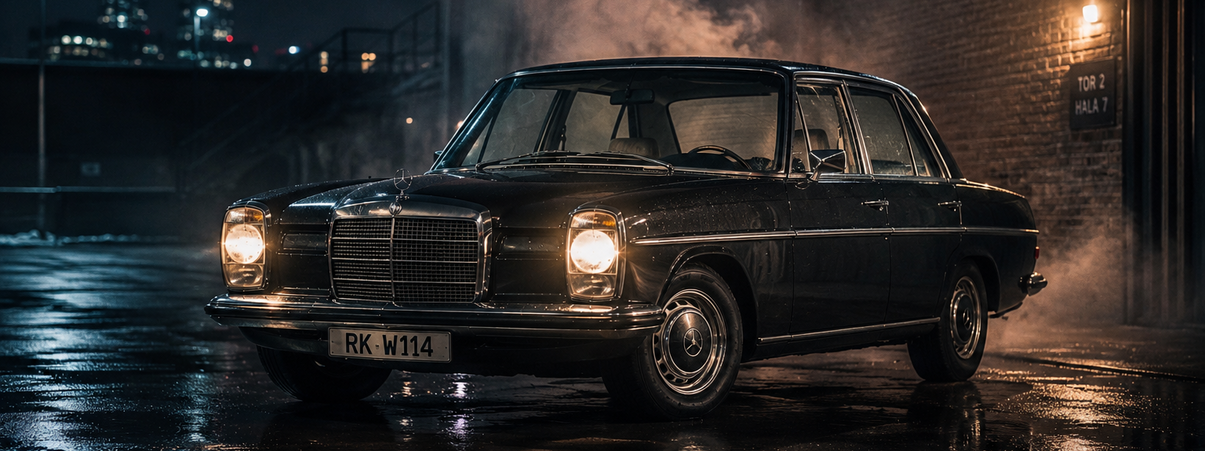
The Story of the W114 and W115
Amidst the mysterious landscape of Norwegian mountains and fjords, I stumbled upon a car abandoned by time and neglected by fate. It rested beneath a farm barn, blanketed by vegetation and ravaged by the passage of time and neglect. We decided to approach the farmer who owned the vehicle and was responsible for its state of disrepair.
"Have you thought about selling it?" I asked the farmer, gazing at the rusted bodywork and damage.
However, after taking a closer look at the car, I turned to my wife and whispered in Polish, "I’m not buying it. Too much work and the repair costs would be too high." Though my head urged caution, my soul stirred at the thought of this abandoned vehicle, which held untold stories within.
As we began to inquire about the technical details of this forgotten car, the farmer mentioned he had the registration document. I waited impatiently for him to return with the paperwork. The moment I laid eyes on that paper trail from the past, I was astonished: the car had been registered for the first time on my twentieth birthday.
I was moved not only by the vehicle's physical condition but also by the thread of destiny woven into this unexpected story.
Ultimately, I decided to buy it, feeling that this car would not only take me on a journey through the Norwegian landscape but also become a part of my own life's journey. The W114 was designed by French automotive designer Paul Bracq, who worked with Mercedes-Benz from 1957 to 1967; its design builds upon that of its predecessors, the W108 and the W108 S-Class, which were introduced in 1965. After his time with Mercedes-Benz, Bracq went on to design cars for BMW and Peugeot.
The "/8" in the name designates all models in the W114 and W115 series. Pronounced "Strich Acht" in German, it refers to the model's production start date: 1968. The car's most significant innovation is its rear suspension—based on semi-trailing arms—which abandoned the outdated swing-axle design in favor of improved stability during high-speed driving and braking.
With the arrival of the W114 series, the tailfins found on the W110 series were eliminated. In addition to the inclusion of four-wheel disc brakes, safety features were added to the W114—such as the semi-trailing arm rear suspension—which improved vehicle handling.
As the saying goes: "No star, no drive." It brings joy, and not just from behind the wheel; it evokes nostalgia wherever it goes, prompting everyone to share their memories.
There is one key difference, however: while diesel engines once reigned supreme in Poland, this car boasts a proud six-cylinder engine and twin Zenith carburetors—confirming it is a W114 model. In 1973, the W114 underwent a facelift that lowered the hood line, widened and lowered the grille, replaced the split front bumpers with a single-piece unit, and repositioned the headlights lower down. Along with other exterior modifications—such as larger side mirrors and ribbed taillights—changes were made to the interior, including a padded four-spoke steering wheel and inertia-reel seatbelts.
There are three main models in the W114 series—the 230, 250, and 280—with coupé variants available for the 250 and 280. Over the course of an eight-year production run, 216,319 units of the 230 (powered by the 2.3-liter M180 engine) were built. Similarly, 154,743 units of the 250 and 92,042 units of the 280 were produced, including their coupé versions. The models were named according to their respective engine displacements (in most cases): 2.3 liters, 2.5 liters, and 2.8 liters, respectively.
My Mercedes 230 /8 is a "Series 1.5" model finished in Dark Olive (291H). It has undergone a comprehensive restoration covering every aspect of the vehicle—both cosmetic and mechanical. The restoration process took eight months.
I call it "Fenix" (Phoenix) because it rose from the ashes—or rather, from the rust—that nearly broke Mr. Sławek, the man who carried out the restoration. My W114 is simply like new.
It’s beautiful!!!
The History of the W114
Why "Strichacht"?
We are often asked where the name "Strichacht" (/8) actually comes from. People also sometimes struggle to match the W114 or W115 designations to specific models.
We’ll try to explain this a bit here. The "/8" designation refers to the model's launch year: 1968. It was intended to distinguish the new "/8" model from previous ones that shared identical model names—for instance, to differentiate the 200D/8 from the 200D "Heckflosse" (Fintail).
The "/8" designation appeared exclusively in writing; it never appeared as a badge or emblem on the car itself.
What do W114 and W115 mean?
The explanation for the /8 model designation system is also simple: all cars with six-cylinder engines—whether sedans or coupes—fall under the W114 series, while all cars with four- or five-cylinder engines belong to the W115 series.
The plan was likely—as had been the case with the "Heckflosse" (Fintail)—to produce two model series in parallel,
with slight variations.
It is likely that—as was the case with the *Heckflosse* ("Fintail")—there were plans to produce two model series in parallel, featuring slightly different bodywork for the four- and six-cylinder versions. These plans did not materialize, yet both series designations remained...
Crucially, these series designations have nothing to do with the specific "Series" classifications, the model years of the /8, or the body styles (sedan vs. coupe), as is often assumed.
The /8 Model Series
Broadly speaking, the /8 is divided into two series: Series 1 and Series 2.
However, so many changes were introduced during the production of Series 1 that experts divide it into three stages: Series 0.5, Series 1, and Series 1.5. All changes made during the production of the /8 model
are listed below (no guarantees implied):
Series 0.5 – production changes
· April 1968
driver's door armrest repositioned higher
· June 1968
modified heater valve
· July 1968
dual windshield washer nozzles instead of a single one
· December 1968
interior rearview mirror in the sedan finished in black instead of chrome
· January 1969
five-speed transmission available as an option for six-cylinder models
· February 1969
reclining seats made standard
· April 1969
debut of the /8 Coupe
· May 1969
changes to the front end (wider radiator grille and radiator itself, battery positioned diagonally rather than perpendicular to the vehicle's axis, modified washer fluid reservoir)
final drive ratio changed from 4.08 to 3.92 for models with four-cylinder petrol engines
Series 1 – changes introduced in August 1968
· dashboard with a different texture; model 250 features wood trim inserts on the dashboard and a larger, foil-covered speaker grille
· introduction of backlighting for ventilation controls and a "DEF" (windshield defrost) setting
· illuminated passenger-side glove compartment made standard
· center console · one-piece unit with an enlarged ashtray (not for cars equipped with air conditioning), new wood grain pattern, soft-touch console
· Model 250 with carpeting on the console side panels (not for cars equipped with air conditioning)
· vent window control knobs: push-fit mounting (previously screw-fixed), with circumferential ribbing and a redesigned face
· carpeting on the floor and door sills instead of rubber mats
· rear parcel shelf carpeted as standard
· new door panels featuring soft PVC foam instead of glass wool
· chrome trim strip on the door pockets only (instead of the door panels themselves), front and rear
· interior colors: beige and gray with a subtle metallic sheen
· seat backrest rear panels featuring trim strips (not with leather upholstery)
· quilted headrest and seat backrest upholstery (not with leather upholstery)
· fender-mounted right-side exterior mirror (optional equipment)
· plaid-patterned material for cognac-colored upholstery (Coupe only)
· hazard warning lights (indicators) as standard
· car jack with integrated crank handle
· key removable from ignition only in position 0 (previously also in position...)
Series 1 – changes during production
· October 1969
Becker Mexico Olympia Cassette Stereo (mono radio with stereo cassette player),
Becker Europa Stereo – first radio model stereo
· November 1969
six-cylinder models with a 3.69 rear axle ratio instead of 3.92 (with 5-speed gearbox: 3.92 instead of 4.08)
· January 1970
window crank handle attached via press-fit with a retaining clip (previously screwed on)
redesigned C-pillar chrome trim (sedan only)
· June 1970
H1 halogen bulbs fitted within the main headlight unit as an optional extra (previously, long-range driving lights were available as an extra-cost option mounted in the fog light position, with fog lights then mounted in a separate housing)
· July 1970
velour upholstery as an optional extra, for Coupé models only
· August 1970
quick-release (hand-operated) oil filler cap
· October 1970
automatic choke for models 200 and 220
padded gear shift lever
wiper arms with a cap (covering the mounting point) instead of an acorn nut
revised rear brake line routing
· November 1970
main exterior light switch with integrated fog light control; simultaneous relocation of parking lights within the main headlights and tail lights
· January 1971
symmetrical heater valve (???)
· February 1971
new paint finish for taxis "hellelfenbein" (623) instead of black (040)
· April 1971
Becker Mexico Cassette (same as Olympia, renamed)
· May 1971
Chassis number moved from the frame to the upper crossmember (near the radiator)
· June 1971
Gear selector markings (for automatic transmission): R-P-D-S-L instead of R-P-4-3-2
· August 1971
Plastic radiator grille instead of sheet metal (W115) or cast aluminum (W114)
· October 1971
Heated rear window with timer
Series 1.5 – changes introduced in April 1972
· new body colors such as yellow (*Gelb*) or red (*Signalrot*); some older colors remained available
· upholstery and interior trim colors completely revised
· dashboard plastic components now finished in textured MB-Tex material
· new upholstery materials
· redesigned, higher-quality door panels
· floor carpets color-matched to the door panels
· for models 250 through 280CE, center console carpeting extended higher up; areas around seat rails remained uncovered
(still no carpeting in these areas for models equipped with air conditioning)
· plastic gear selector surround (on the center console) for automatic transmissions (previously metal on W114/W115 Series 0.5/1 models)
· headrests with ratchet-style adjustment
· modified front fender design near the grille
· black interior rearview mirror stem (previously chrome; Coupe models only)
· ignition lock with a flap covering the key slot (similar to door locks)
· laminated windshield as standard equipment
· intermittent wiper function
· push-button hazard light switch (*Tippkontakt*)
· extensively revised power steering system (optional equipment)
· front end of new 280 models lacks the front bulkhead support strut
· diagonal hood brace · engine with a recess for the air filter housing (for models 280 and 280C)
· screw-on fuse box cover (replacing the push-fit type)
· introduction of models 280, 280E, 280C, and 280CE
· introduction of the 250 model with a 2.8-liter engine in Europe (previously an engine version available only in the USA)
· discontinuation of models 250 (2.5), 250C (2.5), and 250CE
Series 1.5 – production changes
· June 1972
· H4 halogen headlights replacing H1 (optional equipment)
· July 1972
· headlight wipers and washers (optional equipment)
· October 1972
· seat frame with integrated comfort padding (models 200D through 230)
· modified leather upholstery stitching (for models 250 through 280E from the start of production)
· narrower parking brake pedal
· automatic (retractable) seatbelts replacing static ones
· headrests available only in pairs
· removal of "Automatic" badge
· November 1972
· quartz clock
· February 1973
· soft, safety-design steering wheel
· steering-column-mounted lever (likely gear selector) in black instead of chrome
· washer fluid reservoir without "VDO" marking
· introduction of "Taxi" packages International”
Becker Mexico Cassette – fully stereo radio-cassette player (previously a stereo cassette player and mono radio)
Becker Grand Prix Stereo
· March 1973
front headrests standard
automatic seatbelts standard
front bench seat (replacing individual seats) removed from the optional equipment list
large plastic rear fog light
Series 2 – changes introduced in August 1973
· front license plate moved to the bumper
· plastic valance panel under the front bumper (*Haifischmaul* – "shark's mouth") replacing the trim strip
(200D through 230) or the double bumper (250 through 280CE)
· grille wider and flatter; Mercedes star base significantly smaller
· dirt-deflecting fins on the A-pillars
· roof gutters with plastic edging
· water-channeling profile in the chrome rear window frame
· no front quarter-lights (sedan)
· large, internally adjustable exterior mirrors and enlarged front door windows; recess in the upper door panel modified accordingly (to accommodate the new window); on the Coupé, new exterior mirrors mounted
at the rear corner of the (fixed) quarter-lights
· right-hand mirror (optional equipment) moved from the fender to the door (identical to the left, also internally adjustable)
· charging indicator lights · battery, fuel reserve, and brake warning lights featuring symbols instead of text labels; wider high-beam indicator light
· dashboard wood trim made more durable (better protected)
· gear shift lever boot (manual transmission) smooth (previously a pleated bellows)
· ribbed tail lights, made entirely of plastic
· widened trunk lid handle
· model designation font (badge) larger and more angular
· new bumpers (meeting collision regulations) for the US market
· automatic transmission equipped with a torque converter instead of a hydraulic clutch (allows starting in second gear)
· wiper motor reduced in size and featuring a plastic housing
· electric coolant temperature gauge for all models
· carburetor (for four-cylinder engines) positioned lower (deeper) due to oil sump integration (?)
· glove compartment light operates only when the ignition is on
· smaller door contact switches
· improved trunk lighting
· model 220 (petrol) removed from the lineup
· new 230.4 four-cylinder engine
· six-cylinder model designation changed from 230 to 230.
· new 240D diesel engine
· new chassis numbering for Series 2 models, starting at:
100,000 for models 250, 280, 280E, 250C, 280C, 280CE,
200,000 for models 200D, 200, 230.6,
400,000 for model 220D
Series 2 – production changes
· December 1973
front seat backrests raised by 20 mm
· February 1974
metallic paintwork available as an option for the sedan (previously only for the Coupé)
· March 1974
ignition switch with black surround
· May 1974
hood with dual safety latches
· June 1974
firewall (bulkhead) between engine bay and cabin featuring a recess for the modified washer pump
radial tires as standard
locking fuel cap as standard
· July 1974
introduction of the 240D 3.0 model; modified stitching pattern on velour and leather upholstery (including Coupé models)
· August 1974
rear-mounted radio antenna (moved back to the front for models 200D through 250 starting November 1974)
heated seats available as an option
· December 1974
velour upholstery available as an option for the sedan (available from the start of production for 280 and 280E models)
· February 1975
power steering as standard for models 280 through 280CE
· March 1975
Becker Monza Cassette
· June 1975
felt lining (needle-punched felt)
rear parcel shelf area and under-seat areas
· January 1976
Five-speed transmission not available
Becker Monza Cassette Kurier, Becker Europa Kurier stereo radio
Between 1969 and 1976, only 67,048 coupés were produced, representing an estimated 14.5% of the total number of cars manufactured in the W114 series. Of these, 24,669 were 280C and 280CE models, and 42,379 were 250C and 250CE models.
Earlier 250C and 250CE models used the 2.5-liter M114 engine, whereas later 250C models used
the 2.8-liter M130 engine. In contrast, all 280C and 280CE models used the 2.8-liter M110 engine.
0 to 100 km/h in 13.30 seconds, top speed 175 km/h, curb weight 1,355 kg,
The W114 230 features a naturally aspirated inline-6 gasoline engine with the engine code M 180 V 23 / 180.954.
This engine develops a maximum power of 120 hp (118 bhp – 88 kW) at 5,400 rpm and a maximum torque of 178 Nm
at 5,400 rpm. Power is transmitted to the rear wheels (RWD) via a driveshaft and a 4-speed manual transmission. Regarding the chassis details responsible for road holding, handling, and ride comfort:
Front suspension: The W114 features coil springs, control arms, ball-jointed steering linkages, and a stabilizer bar.
Rear suspension: Coil springs, semi-trailing arms, half-shafts, and a stabilizer bar.
Braking: The W114 230 braking system features disc brakes at both the front and rear.
The W114 is a sedan manufactured by Mercedes-Benz; it was sold new between 1967 and 1976.
It is currently available on the used market.
Equipment:
– radio,
– seatbelts.
Originally a Norwegian-market vehicle. A "Series 1" model retaining all characteristic features,
including front windows with vent panes, small side mirrors, two short bumper sections beneath the main front bumper, small taillights, and a narrow trim strip on the trunk lid. The car has undergone a comprehensive restoration, having been stripped down to the last screw and reassembled.
All components have been either refurbished or replaced with new parts. Work performed included, among other things:
– necessary bodywork repairs and a complete respray – covering the body, undercarriage, cabin, and engine bay,
– refurbished carburetors,
– new distributor cap, distributor, spark plugs, and ignition leads,
– new master cylinder, new brake booster, refurbished brake calipers, and new discs and pads,
– a new complete exhaust system,
– new fuel pump and a fuel tank that underwent bodywork restoration,
– a new interior – upholstery, carpets, door panels, and all seals.
The car is fully functional, registered, insured, and road-ready.
This car is a dream come true for me, and in the future, we will spend many wonderful moments together on the road and at classic car meets.
Ryszard Kalinowski